
A Day with Michael Kitchen
How the camera transforms performance - Goldeneye, 1995

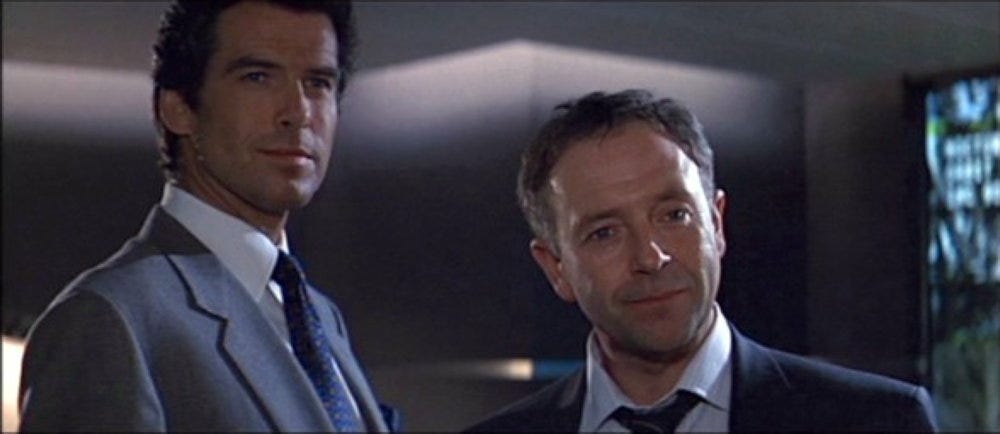
Michael Kitchen played the part of Bill Tanner, M's Chief of Staff in Goldeneye which we shot mainly at Leavesden in 1995. I'd done a few days with him on The Trial the year before where he played Block. Here, like then, he was only with us for a few days. While feature players one can often build up a friendly rapport - Pierce was always chummy, said good morning, knew our names - the smaller parts we were simply polite and cordial - as they were with us. There were a few notable exceptions, but for the most part, with day players it was just cast and crew.
I mention Kitchen here because he was the only actor I ever witnessed who totally transformed himself from set to rushes. Rushes, in the pre-digital era was the footage we shot the day before, processed overnight and viewed on the morning of the following day. As 1st assistant camera I was always at rushes to keep a wary eye out for any soft shots, odd lens or other technical jiggyphobies - and also to answer any questions, Phil Meheux, the DOP, might have had. I always took copious notes on set, so with my trusty notebook I could tell him what lens was on what slate, filter, aperture, etc, if needed. It was always great fun - to see how the hard work of a 120+ crew came together for a few seconds of magic.
Most scenes are blocked first, with the director, DOP, 1st AD and actors figuring out how the scene will play, and where they will all stand, and how it will be shot. Once this is sorted and places are marked for the first set up the crew gets to work to ready the set for that first shot and actors go back to wardrobe, makeup and hair.
Once all is ready it's usual to do a very rough rehearsal or a walk through once we're set up and lit, so Kitchen and Brosnan do their stuff. Some actors give it their all on every rehearsal, while others do a half-speed canter. Kitchen did a sort of hesitant slow, non-acting sort of rehearsal. All well and good, so then we come to shoot - and Kitchen does the same thing again. A sort of slow, ‘reading the script’ delivery that seemed utterly unconvincing and well, bad . I look at Roger the camera operator and he looked back at me, and Campbell (Martin, the director) clearly the wiser - was happy and we moved on. Kitchen did this all day, to my growing consternation - what was he playing at and just how terrible would he look in the rushes?
As it turned out, he was just perfect. It was there, all on the screen utterly convincing, nuanced, powerful, quirkily correct in every detail. He had aced it, and I couldn't see it. Most - not all - actors deliver on the screen what you see on the day, but not Kitchen. He knew exactly what he was up to, and so did Campbell.
I guess that’s why they earn the big bucks.
Jasper Fforde debuted on the NYT best seller list with ‘The Eyre Affair’ in 2001. Since then he has written sixteen other novels which some people say are amusing, satirical, and diverting. For balance, others say they are nothing of the sort. More info at www.jasperfforde.com
Latest publication: ‘Red Side Story’ USA/Canada and UK, 2024.
Next Publication: ‘Dark Reading Matter’ UK and Canada/USA, 2026
My substack contains satire, comedy, thoughts, movie memories and more - it’s free, too. If you like what you read, why not subscribe?
Thank you for sharing these insights into a world we mere mortals on the other side of the lens can only imagine!
I always tell my animation students about 'classical' theatre training and how one learns to act to the balcony, vs film training where one acts to the camera. This is really interesting proof of how one can dial down one's performance so much as to be imperceptible even just beyond the camera. Neat.
Incidentally, Die Another Day is the only film I have ever felt was improved by motion smoothing on an HDTV. Usually it gives me hives and I can't watch, but it turned this big-budget Hollywood flick into a Doctor Who special shot on video in the 1980s and somehow it just ... worked? Did you work on that one? Any insights into how that should be possible? I'm guessing it's something about the style (acting/cinematography) matching the presentation (slightly naff and arch) but I'm curious what a pro might surmise ...